
Fréchette’s Double Standard Is on Full Display—and CAQ’s Black Candidates Are Feeding It
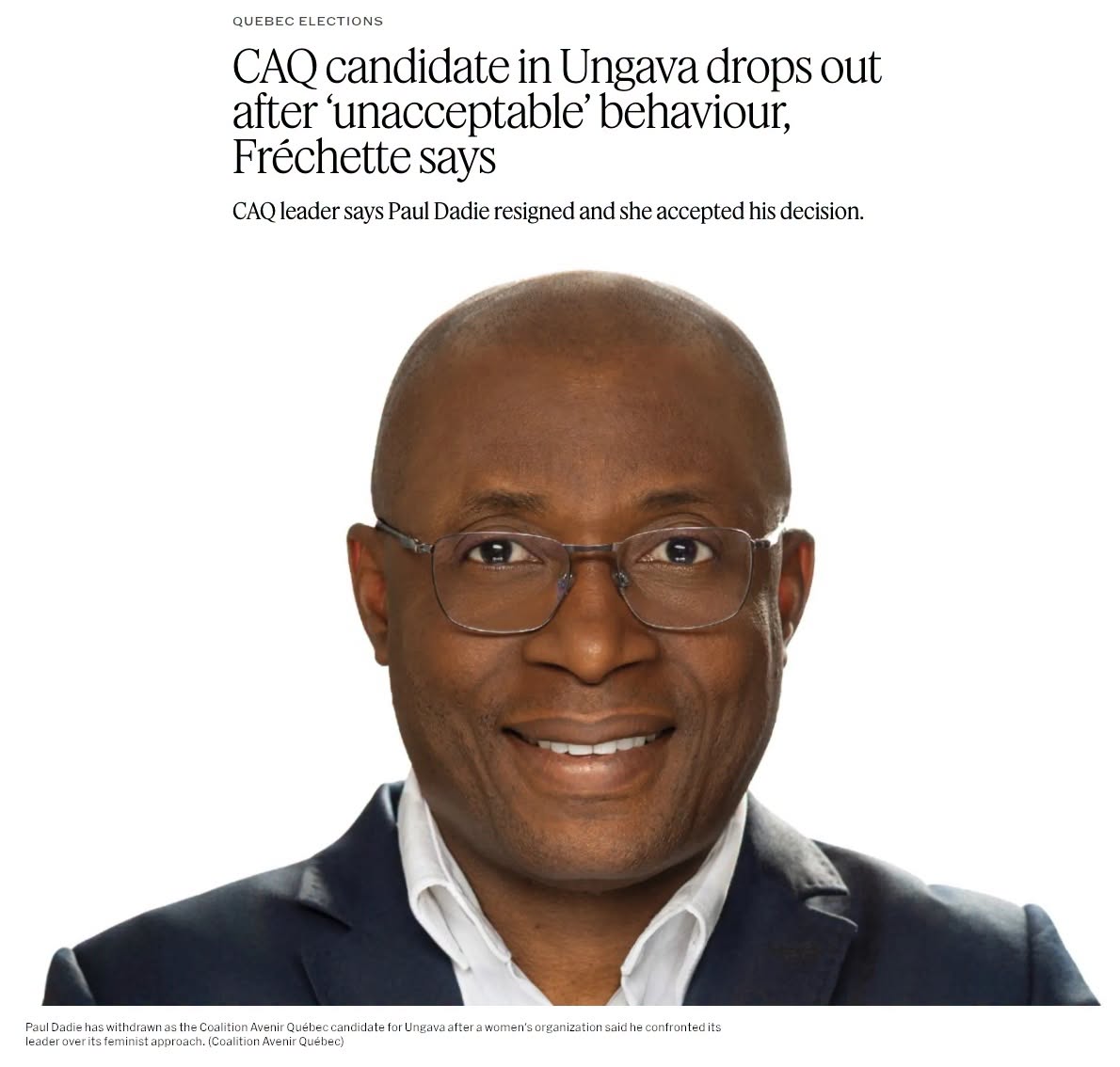
From the SPVM 16 trophies to Dadie’s forced exit, Quebec’s Premier protects white ministers while throwing Black party members under the bus. Here’s why staying silent makes them accomplices.
On Tuesday, September 1, 2026, the Coalition Avenir Québec (CAQ) scrambled into damage-control mode after its Ungava candidate, Paul Dadie, dropped out of the race. His sin? Ignorant, misogynistic comments to the director of the Centre de femmes Les Elles du Nord—questioning their women-only policy, their women-only spaces, and even why they don't hire men. Christine Fréchette, ever the performative leader, condemned him. Dadie—a Black immigrant from Ivory Coast—was predictably pressured to drop out. Wow. Big shocker.
But let's not kid ourselves. Dadie's disgraceful exit is the latest proof of the CAQ's history of treating Black Quebecers worse than white ones. This time, it's one of their own party members. But there's a bigger scandal: so many Black candidates joined this party knowing—or damn well should have known—about the party's anti-Black bias. Trading their dignity for a whiff of power is disgraceful. Not only have they sold themselves out—they're giving the CAQ the cover they need to keep entrenching systemic racism.
Now, I'm sure some Black voters will read this and scream at me: "You're a Black man. Shame on you for not supporting your own!" I've got news for those people: Black people invited to sit at a table with racists aren't respected. They're tolerated so they can be used against their own communities.
Fréchette is no fool. She knows the CAQ is racist—because she's part of the problem. Parading Black candidates is an old trick: use them as props to prove the party can't be racist. Sound familiar? Black Canadians were once barred from enlisting during WWI. Only when the army got desperate did they allow Black men to serve—and even then, only in segregated, non-combat roles. Furthermore, like their American counterparts, Black soldiers came home—not as heroes, but as second-class citizens.
I'm not defending Dadie. I'm calling out Fréchette's double standard. Consider her response to the SPVM Station 39 scandal—sixteen officers being investigated for racial profiling and for ripping out Black men's locks and Muslim women's hair to keep as trophies. The investigation was launched in March 2026 after colleagues of the officers reported the behaviour.
Fréchette condemned the acts but insisted they aren't systemic. As she told Radio-Canada's Patrice Roy: "For me, it's a small group... That's not systemic racism... systemic means on a larger scale."
Someone should remind Fréchette that Quebec's courts don't run on personal beliefs. They run on facts—and legal definitions.
Systemic racism is defined as the implementation of institutional, legal, or social rules—intentional or not—that discriminate against racialized people. Furthermore, racism is a power structure. In the West, that power structure places whiteness at the top and Blackness at the bottom. This is a racist social norm that has existed for centuries.
These officers allegedly acted in concert, imposing their own racist rules and treating Black and Brown motorists as subhuman. And this was accomplished by abusing the SPVM powers they were given. The whistleblowers were reportedly terrified to come to work because they feared reprisals. Why would they be fearful unless they knew it was likely the system would not protect them?
As Quebec's Premier, Fréchette knows this. Yet she consciously insulted the victims of these racist officers by denying that systemic racism contributed to their suffering. Why? For the same reason her predecessor François Legault denied the existence of systemic racism in Quebec: to protect the racist power structure. That shield covers her colleagues, too. Jean Boulet's racist immigrant remarks? No resignation.
Simon Jolin-Barrette's crusade to overturn two court rulings on random street checks—rulings that declared them unconstitutional and enabling of racial profiling? No condemnation. In fact, Jolin-Barrette appealed to the Supreme Court in January 2026 to throw out the decisions of the two lower courts—an act that demonstrates his belief that Black men are inherently dangerous and deserve more police scrutiny than white people.
Civil rights groups condemned Fréchette for her comments. She never apologized. She allowed Boulet and Jolin-Barrette to keep their cabinet positions when she took over from Legault. This is white privilege on full display. As for Dadie? He just wasn't white enough.
Despite these facts, none of the CAQ's Black candidates have withdrawn from the race in protest. That doesn't just raise eyebrows—it reeks of servitude so deep it borders on slave mentality. They'll turn their backs on their communities for a seat at a table among people—especially their leader—who, based on the aforementioned facts, looks down on them.
So let me address the CAQ's Black candidates directly: the thing about being a bootlicker is that your head is always the first one crushed under the slave master's boot the moment they need a scapegoat. Just ask Paul Dadie.
Russell Brooks is a suspense thriller author. If you enjoy reading his essays, please join the mailing list, check out his books and support his work.