
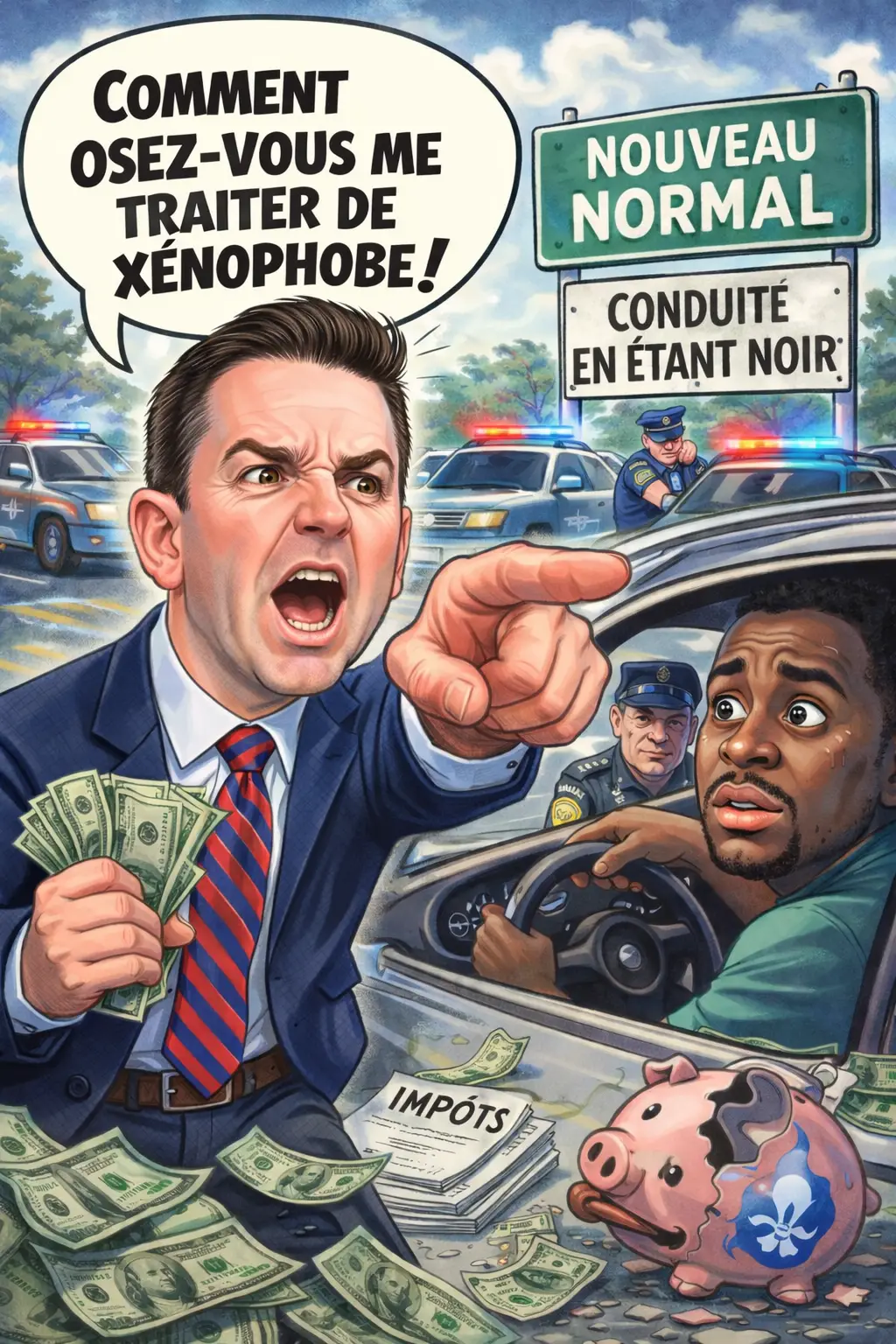
How the CAQ’s Justice Minister is fighting to keep “Driving While Black” alive in Quebec—one court appeal at a time
Simon Jolin-Barrette is very concerned about toxicity in the National Assembly these days. So concerned, in fact, that he recently condemned Québec Solidaire MNA Haroun Bouazzi for daring to suggest that racism exists within Quebec’s hallowed halls.
“Le député de Maurice-Richard est un radical,” Jolin-Barrette declared, clutching his pearls with the intensity of someone who has never once had to wonder whether a routine traffic stop might escalate for no reason other than the colour of his skin.
The irony, of course, is so thick you could spread it on a bagel.
Because while Jolin-Barrette is busy policing the language of those who dare name the problem, his government is actively spending tax dollars to ensure that problem remains alive and well on Quebec’s roads.
Let’s talk about Joseph-Christopher Luamba.
Meet the Man Who Dared to Drive While Black
Joseph-Christopher Luamba is a young Black Montrealer who, like many Quebecers, got his driver’s license and assumed that meant he could… you know, drive. Silly him.
Shortly after getting his license in 2019, Luamba began experiencing something that will sound familiar to countless Black drivers across the province: repeated police stops for absolutely no reason. We’re not talking about one or two “oh, just checking” moments. We’re talking about being stopped approximately a dozen times over 18 months.
The punchline? None of those stops resulted in a single ticket.
Not one.
Luamba, perhaps operating under the quaint notion that the Canadian Charter of Rights and Freedoms actually means something, decided to do something about it. He sued, with support from the Canadian Civil Liberties Association.
And here’s where it gets interesting for anyone who still believes the justice system works.
The Courts Actually Did Their Jobs
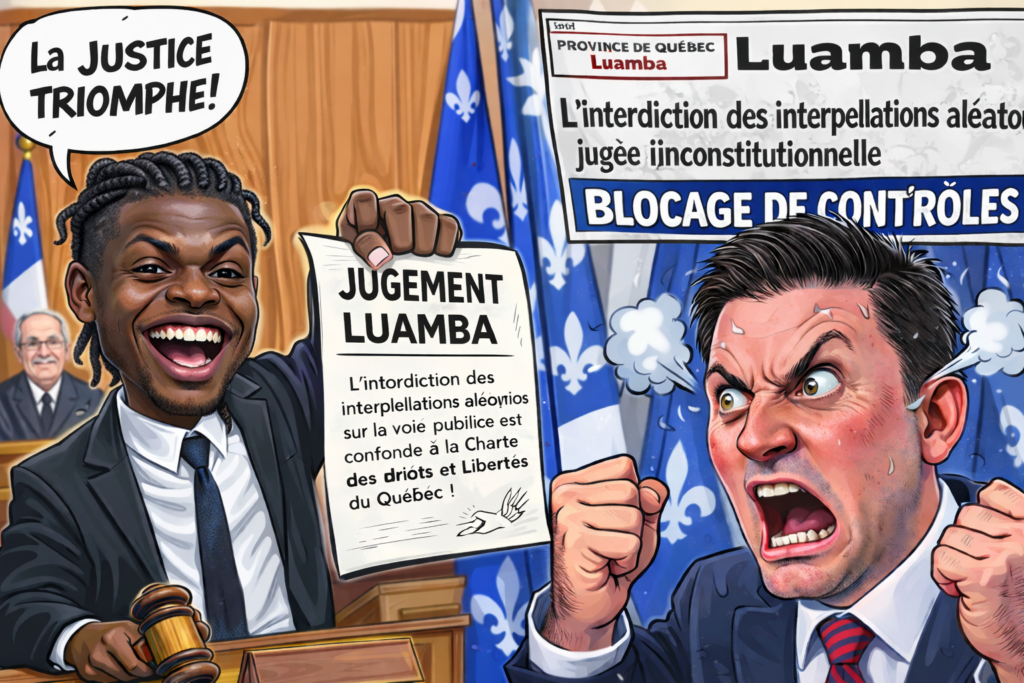
In 2022, Quebec Superior Court Justice Michel Yergeau ruled that random police stops create a “safe conduit for racial profiling against Black drivers”. He declared the provision of Quebec’s Highway Safety Code allowing these stops to be inoperative.
The Court of Appeal upheld this decision in 2024, unanimously finding that the law violates Charter rights, including the rights to freedom from arbitrary detention and equality rights.
Two courts. Two rulings. Both saying the same thing: random stops lead to racial profiling, and that’s unconstitutional.
You might think this would be the moment the government paused to reflect. Perhaps to acknowledge that maybe—just maybe—systemic racism exists in Quebec after all.
Instead, Jolin-Barrette announced an appeal to the Supreme Court of Canada.
The Minister’s Masterful Logic
Here’s how Jolin-Barrette justifies spending public money to defend a practice courts have twice ruled unconstitutional:
“For us, it’s important to ensure that police officers have the tools they need to do their job” .
The “tool” in question? The power to stop any driver, at any time, for any reason—or no reason at all—based on nothing more than an officer’s discretion.
When asked what specific errors of law the lower courts made, Jolin-Barrette refused to provide examples, stating that he wouldn’t “debate it in public”. The government’s case, he assured reporters, would be in the request for authorization filed with the Supreme Court.
So the public gets to fund the appeal, but not hear the actual arguments. Neat system.
Public Security Minister François Bonnardel added his own flourish: while racism “may have been a problem in the past,” random stops save lives by catching drunk drivers. Never mind that the ruling explicitly did not affect structured operations like sobriety checkpoints, where drivers are stopped systematically. Never mind that experts couldn’t produce data showing that random stops actually improve road safety.
But why let facts get in the way of a good talking point?
The Hypocrisy Hall of Fame
Now, let’s return to our hero, Simon Jolin-Barrette, defender of legislative dignity and scourge of anyone who dares name racism in his presence.
When Haroun Bouazzi stated the obvious—that racism exists in the National Assembly—Jolin-Barrette was quick to condemn. When Bouazzi, frustrated by the government’s refusal to debate a motion on Gaza, shouted “History will judge you,” Jolin-Barrette labelled him a “radical” who doesn’t respect the Assembly.
But let’s review what Jolin-Barrette’s government actually does:
- Denies systemic racism exists despite the Viens commission documenting discrimination against Indigenous peoples, despite the death of Joyce Echaquan, and despite two court rulings confirming racial profiling against Black drivers.
- Wastes taxpayer dollars appealing those very court rulings to defend a practice proven to disproportionately target Black drivers.
- Acknowledges in court filings that racial profiling is a “major problem” while refusing to name it politically.
- Protected Jean Boulet—the minister who claimed “80 per cent of immigrants… don’t work, don’t speak French”—by simply moving him to a different cabinet portfolio.
- Helped force out Me Tamara Thermitus, the first Black president of the Quebec Human Rights Commission, based on a biased investigation, a court later found violated her right to procedural fairness.
But sure, Haroun Bouazzi is the real problem here.
What’s Actually at Stake
The Supreme Court heard arguments in this case in January 2026. Federal and provincial governments lined up to defend random stops, arguing they’re necessary to combat impaired driving and to check licenses.
On the other side, civil rights groups and lawyers representing Black and Indigenous communities presented data showing that racialized drivers are stopped more frequently—proof that profiling is a direct result of a law with no guardrails to prevent abuse.
Fernando Belton, a criminal lawyer, pointed out that the 1990 Supreme Court decision upholding random stops was made “at a time when few studies existed on racial profiling and its nefarious effects”. Upholding the law now, he argued, “would amount to authorizing the continued violation of the fundamental rights of Black communities, but this time… they would act with full knowledge of the devastating causes and consequences of racial profiling”.
Sabrina Shillingford of the Black Legal Action Centre put it even more bluntly: “The evidence tells us that the law predictably produces discriminatory effects for Black drivers and therefore cannot be upheld”.
The court has taken the case under advisement.
The Bottom Line
Simon Jolin-Barrette can condemn Bouazzi all he wants. He can call him a radical, question his respect for the Assembly, and play the role of the offended institutionalist.
But here’s the thing: actions speak louder than condemnations.
And the CAQ’s actions are speaking volumes:
- Denying racism while appealing rulings that prove it exists.
- Protecting ministers who make racist statements.
- Targeting Black leadership while defending policing practices that target Black drivers.
- Spending public money to keep “Driving While Black” alive and well in Quebec.
Bouazzi might be “radical” for shouting that history will judge the government. But history will also judge a government that fought to preserve unconstitutional policing practices while pretending the problem doesn’t exist.
Jolin-Barrette wants to lecture about dignity and respect while his government normalizes racial profiling. The audacity is Olympic-level.
Calling out xenophobia isn’t the problem, Simon. Appealing to the Supreme Court to protect racially biased policing while claiming systemic racism doesn’t exist—that’s the real toxicity.
And you’re trying to bring back Jim Crow one taxpayer-funded appeal at a time.
The Supreme Court of Canada’s decision in Attorney General of Quebec v. Luamba is pending. The case could have implications for random traffic stops across the country.
Russell Brooks is the author of five suspense thrillers. His sixth, The Cadmus Imperative, is currently in the works.